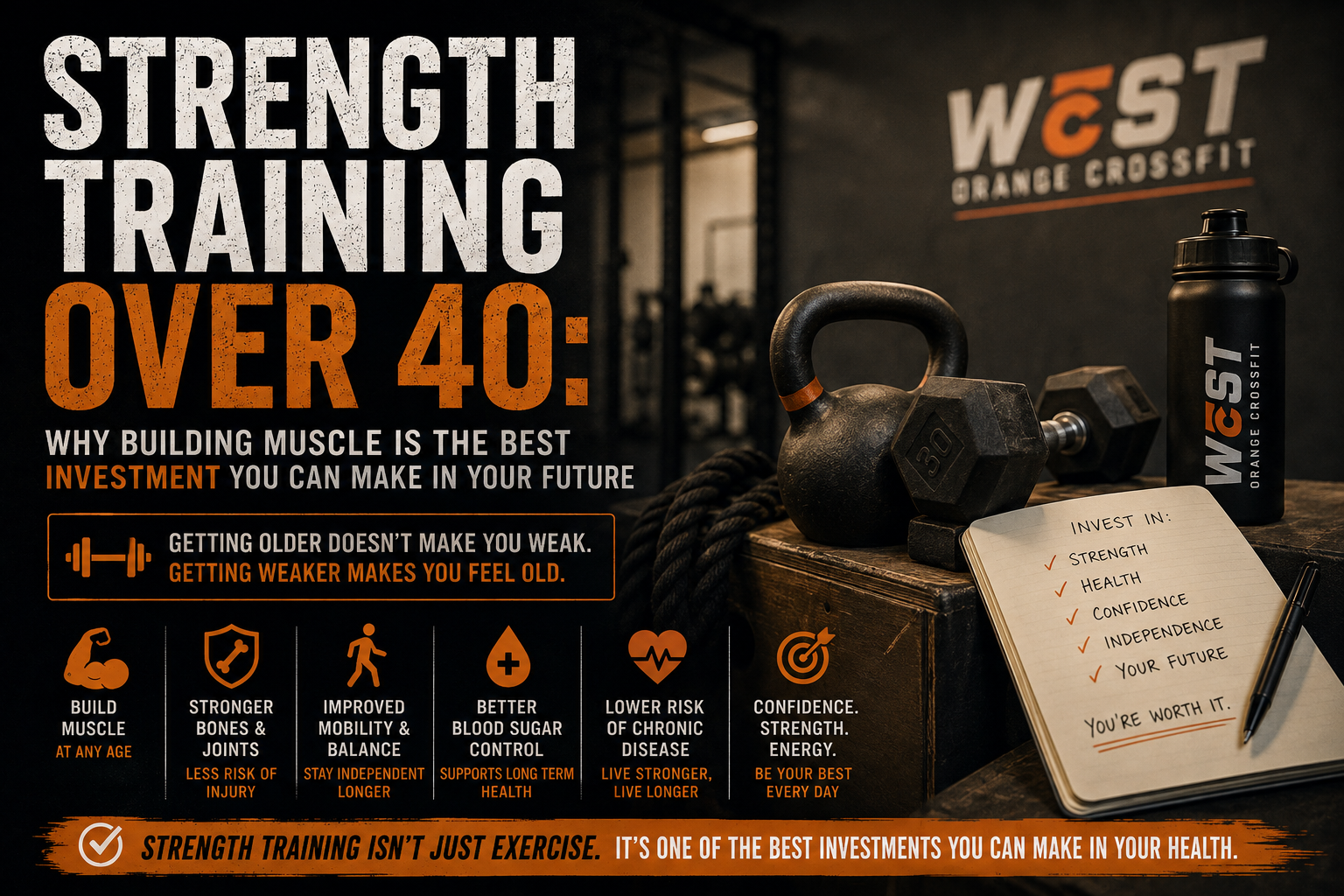
Strength Training Over 40: Why Building Muscle Is the Best Investment You Can Make in Your Future
Strength Training Over 40: Why Building Muscle Is the Best Investment You Can Make in Your Future
By
August 6, 2026

Yes.
In fact, it may be one of the safest and most beneficial forms of exercise when it's done with good coaching and proper progressions.
The key isn't lifting the heaviest weight possible.
It's learning good movement, starting where you are, and gradually building strength over time.
Every workout can be scaled to your current fitness level, previous injuries, and experience.
Our goal isn't to beat you up.
It's to help you get stronger safely.
For most people, 2 to 4 sessions each week is the sweet spot.
That gives your body enough training to build strength while still allowing time to recover.
Remember, consistency matters more than perfection.
Showing up three times every week for a year will always beat training six days one week and skipping the next three.
Absolutely.
Research has shown that adults in their 50s, 60s, 70s, and even 80s can build muscle and gain strength through progressive resistance training.
You may not recover exactly like you did at 25.
But your body is still incredibly adaptable.
It's never too late to become stronger than you are today.
This is one of the biggest misconceptions about strength training.
When done correctly, strength training often helps support your joints by strengthening the muscles around them.
Stronger muscles create more stability.
More stability often means less stress on your knees, hips, shoulders, and back during everyday life.
Many people actually find that aches and pains improve as they become stronger.
No.
Strength training is one of the best places to begin.
Building muscle improves your metabolism, helps regulate blood sugar, supports fat loss, and makes everyday movement easier.
You don't need to "get in shape" before joining a gym.
That's exactly what the gym is for.
It doesn't have to be.
One of the biggest misconceptions about CrossFit is that everyone does the same workout with the same weight.
That's not how good coaching works.
Every movement, weight, and workout can be adjusted to match your current fitness level.
Whether you're brand new to exercise or have been training for years, the workout should challenge you, not the person standing next to you.
That's why coaching matters.
The benefits of strength training aren't based on opinion.
They're supported by decades of research.
Studies consistently show that resistance training can:
One of the strongest predictors of healthy aging isn't how much you weigh.
It's how strong you are.
That's why we believe strength training isn't just exercise.
It's one of the best long-term investments you can make in your health.
American College of Sports Medicine. ACSM Position Stand: Progression Models in Resistance Training for Healthy Adults.
American College of Sports Medicine. ACSM Guidelines for Exercise Testing and Prescription.
Centers for Disease Control and Prevention (CDC). Benefits of Physical Activity for Older Adults.
National Institute on Aging. Exercise and Physical Activity: Your Everyday Guide.
Fragala, M. S., et al. (2019). Resistance Training for Older Adults: Position Statement From the National Strength and Conditioning Association.
Peterson, M. D., et al. (2010). Resistance Exercise for Muscular Strength in Older Adults: A Meta-Analysis.
Westcott, W. L. (2012). Resistance Training Is Medicine: Effects of Strength Training on Health.